Commitment to Moderation & Responsibility
Responsible Drinking
The distilled spirits industry urges adults who choose to drink to do so responsibly and in moderation, consistent with the current and previous Dietary Guidelines.
The 2025-2030 Dietary Guidelines for Americans, which forms the basis of federal nutrition policy and programs, was released in January 2026. The Dietary Guidelines longstanding overarching advice has been that if alcohol is consumed, it should be done in moderation. If adults of legal purchasing age choose to drink, they should: “Consume less alcohol for better health.” The updated guidelines are consistent with the 2020-2025 Dietary Guidelines for Americans, which advised that “drinking less is better for health than drinking more” and that “there are also some people who should not drink at all.”
As a long-time partner on the Dietary Guidelines, DISCUS helps disseminate the alcohol recommendations and promotes moderation and responsibility.
Moderation & Responsibility at Home
Drinking in Moderation
The Dietary Guidelines research defines moderate drinking as up to two standard drinks per day for males and one per day for females.
The Dietary Guidelines also note that some individuals should not drink beverage alcohol, including pregnant women, people who are recovering from alcohol use disorder or are unable to control the amount they drink, and people taking medications or with medical conditions that can interact with alcohol. For those with a family history of alcoholism, be mindful of alcohol consumption and associated addictive behavior.
The Distilled Spirits Council recommends that adults who have questions regarding alcohol and health should discuss the potential risks and potential benefits with his/her physician who can determine what is best for that person based on individual risk factors, such as family history, genetics and lifestyle. DISCUS does not recommend that people drink beverage alcohol for potential health benefits. Alcohol abuse can cause serious health problems.
Knowing What Counts as a Drink
According to the Dietary Guidelines research: “moderate alcohol consumption is defined as consuming alcoholic beverages up to the limit defined by the Dietary Guidelines for Americans, meaning, two drinks or 28 grams of alcohol in a day for men and one drink or 14 grams of alcohol in a day for women.”

In the United States, one ‘standard drink’ contains 14 grams (0.6 ounces) of alcohol. Examples of standard drink equivalents include: 12 oz 5% alcohol by volume (ABV) beer, 5 oz 12% ABV wine, 1.5 oz 40% ABV or 80 proof distilled spirits such as vodka, risk, and rum; and 12 oz 5% ABV ready-to-drink beverages. Each standard drink equivalent contains the same amount of the same pure alcohol (ethanol).
That’s why, when it comes to drinking alcohol, there is no beverage of moderation, only the practice of moderation.

The Science behind Moderation
Every five years, the federal government updates the Dietary Guidelines with the best and most recent evidence. The 2025-2030 Dietary Guidelines for Americans for alcohol are based on a Congressionally-directed evidence review conducted by the National Academy of Sciences, Engineering, and Medicine (NASEM) in 2024. The NASEM Consensus Study report, which is part of the Scientific Foundation document accompanying the new Dietary Guidelines, concluded, in part, that those who drink in moderation have a decreased risk of cardiovascular disease and a lower risk of all-cause mortality. The report also linked moderate alcohol consumption with an increased risk of breast cancer.
The Distilled Spirits Council recommends that adults who have questions regarding alcohol and health should discuss the potential risks and potential benefits with his/her physician who can determine what is best for that person based on individual risk factors, such as family history, genetics and lifestyle.
DISCUS does not recommend that people drink beverage alcohol for potential health benefits. Alcohol abuse can cause serious health problems.
Information on Alcohol and Health
The potential health impact of consuming alcohol is an important consideration in deciding whether or not to drink beverage alcohol. DrinkInfo seeks to provide resources to those wishing to learn more about making responsible alcohol choices. DrinkInfo is a website created and funded by the Distilled Spirits Council to provide general information on alcohol and health.

Serving Facts Labeling Commitment
In 2022, the DISCUS Board of Directors made a commitment to provide Serving Facts information for all spirits products available for sale in the United States.
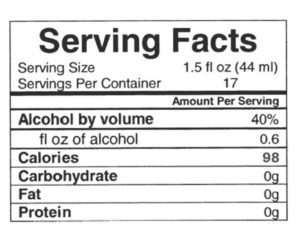
By June 2024 or earlier, DISCUS Director Members began adding the following information to the label or to a website included on their label:
-
- Serving size
- Number of calories per serving size
- Grams of carbohydrates per serving size
- Grams of protein per serving size
- Grams of fat per serving size
The Director Members’ commitment to provide “serving facts” information was announced by DISCUS on Sept. 28, 2022 as part of the White House Conference on Hunger, Nutrition and Health. DISCUS’ support of the conference and the stakeholder commitment by its Director Members was highlighted and commended by the CDC Foundation.
The “Serving Facts” information is provided in a TTB approved format and located either on the product label or on a company website with an on-label QR code or website reference. TTB currently provides two approved formats through a serving facts panel or statement of average analysis. This is in addition to all of the other information that has long been required to provide consumers with information about the contents of spirits products, such as alcohol content, defined class and type, and statement of composition (for many products).
The scope of this commitment, however, does not extend to limited-run test products available on-site at production facilities and tasting rooms and will only apply to new labels. Members will be permitted to deplete existing label stock before printing new labels with this information.
Many DISCUS members have made individual commitments to provide this information over the years, and DISCUS is pleased to bring together a commitment of the larger distilling community. An example of a new spirits label is below.